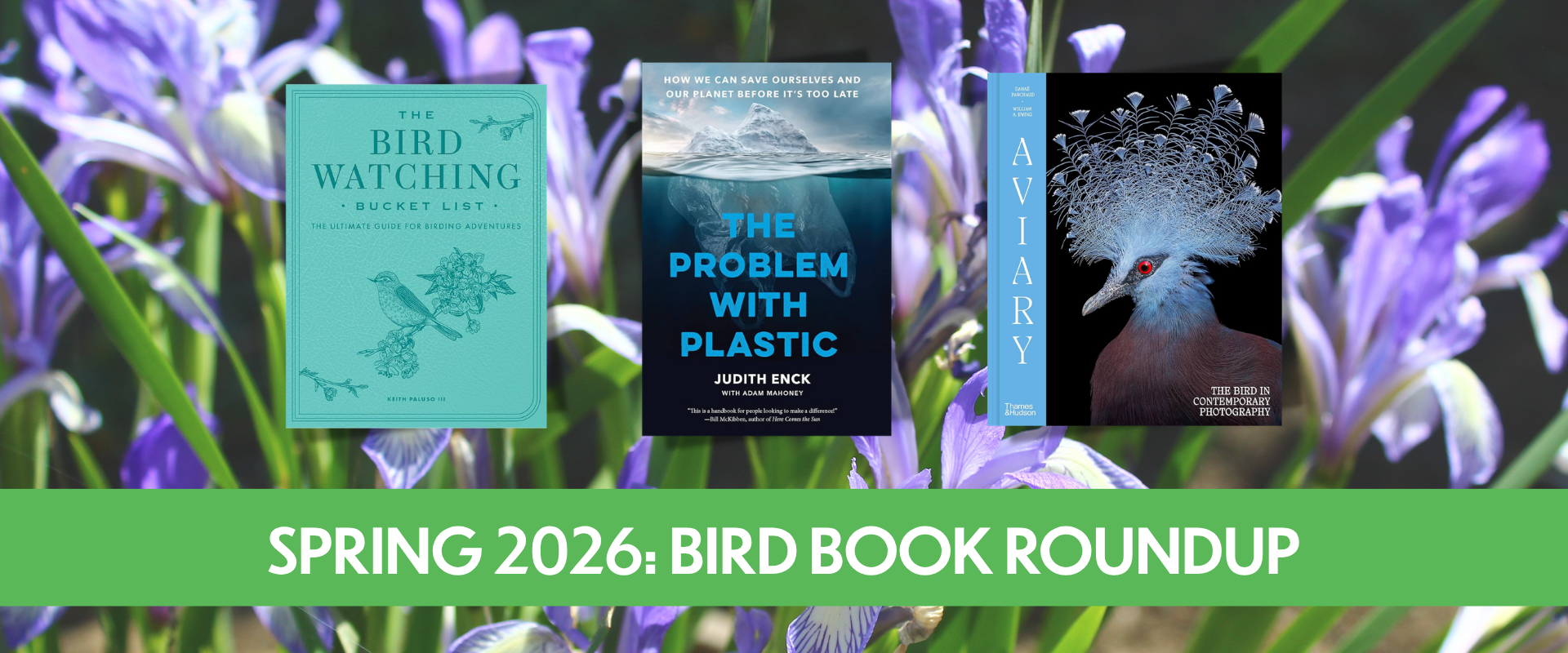
This illustrated journal is set up for users to identify a selection of species across North America. The book features 60 bird species which are grouped into four broad habitat types: 1.) Marshes, Lakes and Rivers, 2.) Oceans and Coastlines, 3.) Woodlands, and 4.) Deserts, Grasslands, and Open Country. For each selected species, there are two dedicated pages with some basic identification information and space for recording observations, sketches, and keeping track of the number of birds observed. Paluso’s introduction also provides an overview of birding ethics and a list of additional resources for those who want to do a deeper dive.
While in no way a comprehensive list of birds that would make it onto one’s life-long bucket list, the book provides a nice balance of rare and common birds one would find in the various habitats as they travel across North America. One of Paluso’s most helpful tips is for birders to follow his “Ten-Minute Rule.” This rule suggests that one simply stay in one place quietly for ten minutes before moving to another location. This allows the area to settle and for one’s senses to become accustomed to the sights and sounds. His formula for each species is to record the same set of information on a checklist which identifies the plumage, sex, behavior, date, time, location, temperature, bird calls, and description of the habitat. This formulaic approach to observing each species is an excellent way for novice birders to start thinking about how birds are integrally connected to place and time.
One drawback with the guide is that even with two full pages dedicated to each species, there is limited space for detailed field notes and sketches of the bird and habitat. To make up for this and to account for birds that are not included in the guide, Paluso includes a section towards the end of the guide entitled “Free Birds,” where one can find empty worksheets for including additional notes on birds observed.
The publication is beautifully put together in a flexible bound cover. While it may be a bit large to take out in the field for trailside writing, it makes for a lovely book to record one’s thoughts upon returning home. Paired with a small field notes journal and some more detailed field guides for specific regions of North America, this is an excellent start to a life list and helps to build one’s observation skills in a meaningful way.
Plastic – It’s Worse Than You Think!
Book Review: The Problem with Plastic by Judith Enck with Adam Mahoney
By Carol Peace Robins, Publications Committee Member
The word “problem” is truly an understatement. In The Problem with Plastic, Judith Enck and Adam Mahoney provide convincing evidence that plastic is, in fact, toxic. It’s poisoning our environment, wildlife, oceans, and air – even our bodies.
Enck was a former Environmental Protection Agency administrator in the Obama administration. She’s also the founder of Beyond Plastics, a nationwide project based at Bennington College where she’s a professor. With Mahoney, a climate and environment reporter, together they paint a frightening picture of what plastic is doing to us.
Most people know that plastic pollutes oceans and rivers. As the authors point out, all kinds of plastic end up there, eventually breaking down into tiny microplastics that fish often mistake for food. Then we eat the fish along with these mini particles. In a more convoluted path, microplastics infiltrate our tap water, air, clothing, and the toys our kids play with. But most of all, they’re found in all those single-use takeout containers and the food and drinks inside. All of us, humans and animals alike, wind up with microplastics in our arteries, urine, breast milk, even our hearts and brains.
The “problem” begins with fossil fuel companies (already major polluters of air and water) that also build enormous petrochemical factories for making plastic. Many of them are situated along the Gulf Coast in Texas and Louisiana where, the book tells us, federal data in 2021 concluded that more than 90% of the area’s greenhouse gas emissions come from factories in eighteen low-income, minority communities found there. No wonder one area is called “Cancer Alley.”
Unfortunately, recycling doesn’t help. Only 5% or 6% of what we “recycle” actually gets recycled. Simple plastics like bottles do. But most others are too complex. Yet plastic producers gladly promote recyclable products. Why? So they can keep making products that people have trouble avoiding while offering a false sense of assurance.
What can we do about it? Enck and Mahoney have recommendations for us all. Contact our government leaders to insist on strictly regulating the amount of plastic produced. Replace our plastic kitchenware with glass, ceramic, or metal versions. Always carry a reusable water bottle, tote bags, and produce bags. Use bars of soap, not bottles. Choose natural fibers, not synthetics. All worthwhile practices.
The book does a very important job of convincing us how dangerous plastic can be. But it doesn’t highlight the obvious next step: finding plastic’s replacement. Bamboo? Other vegetation? It’s not easy, but it’s absolutely essential. And it’s out there somewhere.
A Visceral Journey for Spring
Book Review: Aviary: The Bird in Contemporary Photography
By Suzanne Charlé, Publications Committee
New York City Bird Alliance birders have, no doubt, many books on birds: field guides, explorations into natural history, chart-topping memoirs.
Unlike guide books and field guides, Aviary: The Bird in Contemporary Photographytakes readers on a visual journey, weaving images from documentary, art, portraiture, ornithology, and wildlife photography. With over 200 photographs by 50-plus international photographers, authors Danaé Panchaud and William A. Ewing explore our complex relationship with birds.
Beginning with an extraordinary portrait gracing the cover, Victoria Crowned Pigeon by Tim Flach lets us know that Aviary is no ordinary book. Rather than organizing the contents by species, habitat, or physical traits, the authors – two leading photography experts – explain how they “approach the book as a play unfolding in six acts,” with twists and turns, exploring our relationship with birds – beautiful, complex, sometimes humorous, occasionally grim.
Photographers pursue “their muse” in every part of the planet, with shots of the birds in the air, under water, into cities, and in scenes devised by the artist. In “Act I: Sanctuary,” we see Junji Takasago’s Heavenly Flamingos on the Uyuni Salt Flat, Bolivia (and they are, indeed heavenly), while visual artist Xavi Bou reveals flight paths traced by birds in the Icelandic sky in Ornithography #102, part of a project he has explored for over a decade.
Photographing birds can be challenging, requiring great patience and an intimate knowledge of the bird. Mario Cea spent six months searching for the best area to carry out photo shoots of the kingfisher and studying the animal’s behavior. His reward: The Blue Trail in “Act II: Proximity” captures a kingfisher, frozen in time, plunging into water. The pond, he explains, had been dug years ago to extract gravel; now filled with water from a nearby river, “it is a completely natural ecosystem.” The Blue Trail, he adds, is “made only with photographic techniques,” such as a slow shutter speed of 1/15th of a second and several bursts of flash to freeze the motion. This is a straight shot “with no special production tricks.”
Many birds are captured in their natural habitats. A pair of Red-crowned Cranes perform an elegant courtship in the snow in Japan (Michael d’Oulremont) while a pigeon in a window gazes at the Empire State Building (Andrew Garn). Others are placed in sites by the photographers: Exploring cultural heritage, Karen Knorr photographed an egret – a symbol of purity and love – in Abu Dhabi’s Grand Mosque, typically found in nearby salt flats. Here, too, are intimate portraits, some wise, some coy, some direct: ‘Duke No.I’ Eastern Grass Owl (Leila Jeffreys); Flamingo (Robert Clark); even a Northern Cardinal (Tim Flach) – here’s looking at you!
In short, Aviary is a brilliant visual study of the relationship between humans and birds, offering new ways to think about birds, our interactions with them, and our impact on them – and the larger world.
Support independent bookstores by purchasing these titles and more at Bookshop.org.
.png)
.png)
.png)
.png)