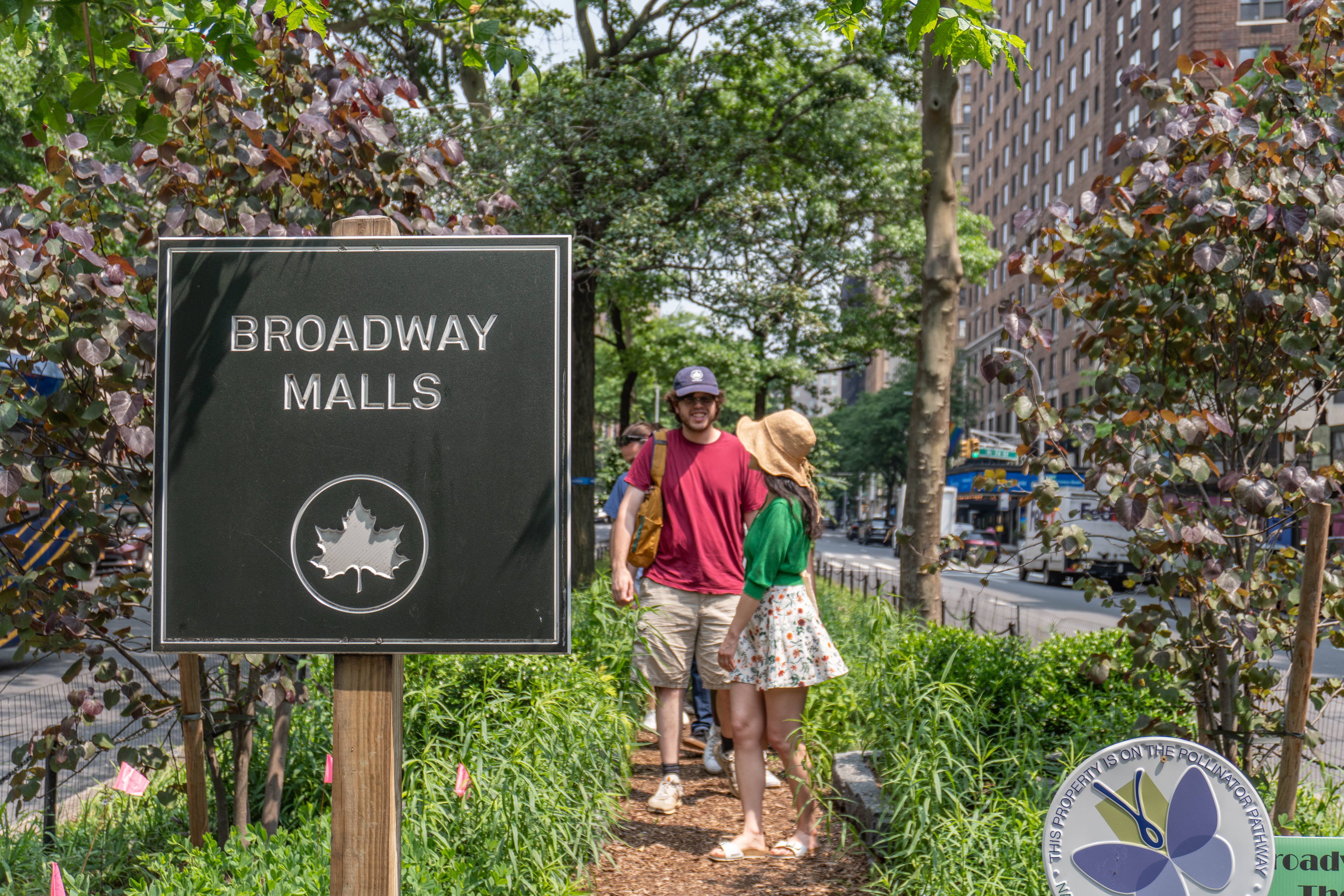
Community members tour the Broadway Malls after a ribbon-cutting ceremony in celebration of recent restoration. Photo by NYC Bird Alliance
By Carol Peace Robins, Publications Committee Member | April 1, 2026
For five miles along Broadway, the street medians are small green islands known as the Broadway Malls. For 30 years, the Broadway Mall Association (BMA) has maintained these planted malls, adding trees, shrubs, and flowers, but also benches and art installations for millions of New Yorkers in the Upper West Side, Morningside Heights, West Harlem, and Washington Heights.
BMA’s latest effort to enhance the 10.6 acres of parkland is called The Great Green Way project. The BMA horticulture team, led by Director of Horticulture Ian Olsen, began the project in 2024, using locally adapted (native) plants to provide better-quality habitat for insects and the 25 million birds that pass through the City every spring and fall.
In 2025, BMA contracted NYC Bird Alliance’s science team to assess bird activity in restored malls versus traditionally planted ones. How many birds visit this narrow but expansive green space? Do migrants use the habitat? Does restoration affect biodiversity?
"Collaborating with NYC Bird Alliance was a natural connection for BMA's Great Green Way initiative,” said Ian. “We wanted to measure the exact impact these native plants have on our wildlife.”
Myles Davis, NYC Bird Alliance’s senior manager of green infrastructure, designed a study that would be the City’s first large-scale analysis of street medians as bird habitats.
During 2025’s spring and fall migration seasons, NYC Bird Alliance scientists paid weekly visits to 22 malls between West 73rd and West 169th Streets. Three malls along this stretch had completed restorations, sixteen were slated for restoration, and three were traditionally planted, with no restoration planned.
Using what’s called “point counts,” each surveyor first stood still for five minutes and recorded the number of birds and species seen or heard. An American Robin foraging for nesting material; an American Kestrel on a nearby rooftop; a Barn Swallow passing overhead. Then the surveyor did a walk-through to further document species richness and bird abundance. Carefully navigating unruly hedges and the occasional litter, not to mention taxis and buses whizzing by, our scientists were on high alert. Then, it was on to a nearby control site – often an adjacent avenue with no malls or green space – to compare bird activity.
The results have been a hit: birds use the malls as rest stops and 36% of species found were long-distance migrants. Overall, 39 species (including the American Redstart and Baltimore Oriole) were documented as using the malls, and 25 of them were interacting with the native-planted habitats. Furthermore, bird numbers and species are greater at restored malls. Our scientists found 80% more species and 57% more abundance compared to nearby control sites without planted medians.
“These early, clear results provide essential evidence to advocate for similar habitat restorations across the City, benefiting the local environment for birds and people,” said Dr. Dustin Partridge, NYC Bird Alliance’s director of conservation and science. He credited the organization’s “solid team of scientists” and BMA’s vision and commitment, whose “investment in native biodiversity and desire to quantify the impact through monitoring will ultimately motivate others to invest in habitat restoration.”
“It is wonderful to see that the bird survey validates that even the initial restorations are providing better habitat for local and migratory birds in the middle of busy Manhattan," said Andrew Genn, BMA executive director. “We look forward to continuing this collaboration between our organizations.”
NYC Bird Alliance will continue this research through 2026. With such novel and important data, the findings will be submitted for publication in a scientific journal, providing the credible, peer-reviewed evidence needed to inspire habitat restoration projects in cities nationwide. As we observe more birds and species making their Broadway appearance, these findings will encourage more restored medians in and beyond New York City, for the benefit of birds and people.
.jpg)