Aviary: The Bird in Contemporary Photography
category: GENERAL
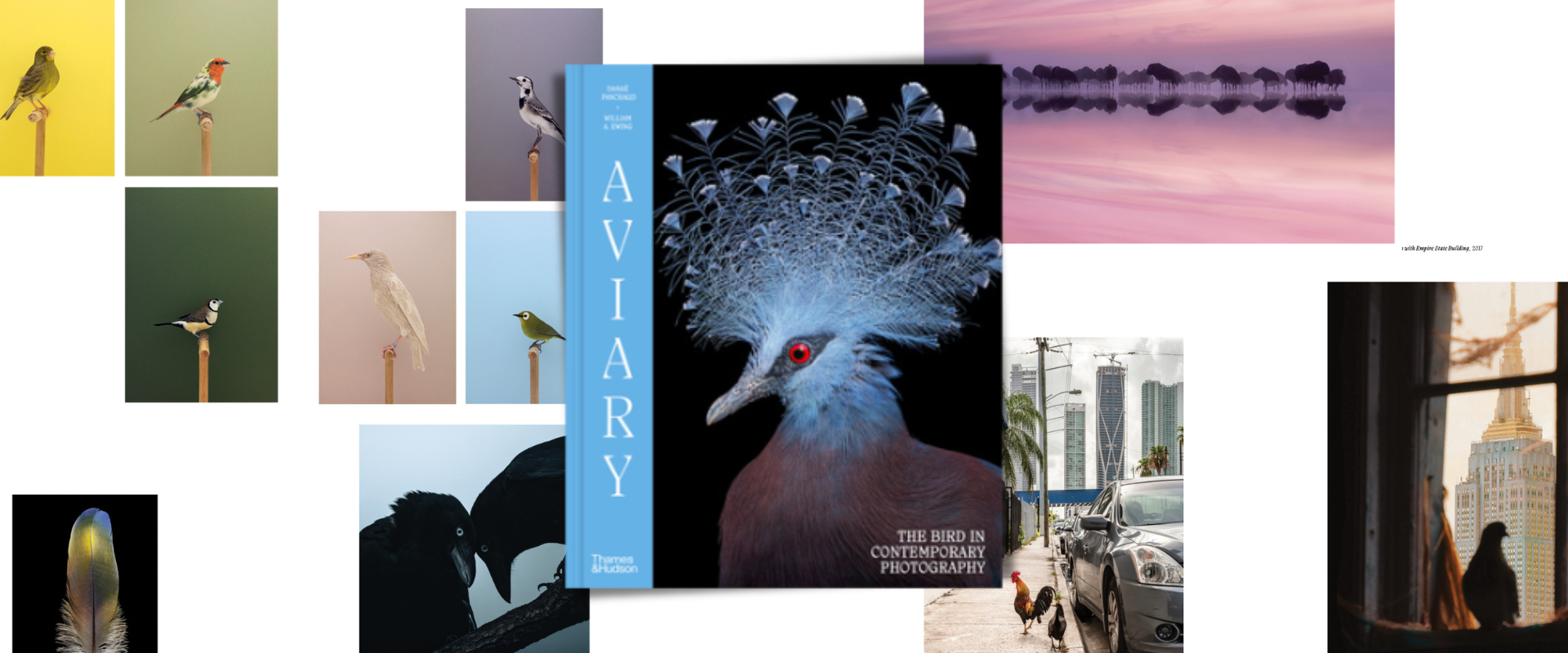
Featured photographs from Aviary: The Bird in Contemporary Photography, courtesy of Thames & Hudson.
Suzanne Charlé, Publications Committee | March 5, 2026
Suzanne Charlé, Publications Committee | March 5, 2026
New York City Bird Alliance birders have, no doubt, many books on birds: field guides, explorations into natural history, chart-topping memoirs.
Unlike guide books and field guides, Aviary: The Bird in Contemporary Photography takes readers on a visual journey, weaving images from documentary, art, portraiture, ornithology, and wildlife photography. With over 200 photographs by 50-plus international photographers, authors Danaé Panchaud and William A. Ewing explore our complex relationship with birds.
Beginning with an extraordinary portrait gracing the cover, Victoria Crowned Pigeon by Tim Flach lets us know that Aviary is no ordinary book. Rather than organizing the contents by species, habitat, or physical traits, the authors – two leading photography experts – explain how they “approach the book as a play unfolding in six acts,” with twists and turns, exploring our relationship with birds – beautiful, complex, sometimes humorous, occasionally grim.
Photographers pursue “their muse” in every part of the planet, with shots of the birds in the air, underwater, into cities, and in scenes devised by the artist. In “Act I: Sanctuary,” we see Junji Takasago’s Heavenly Flamingos on the Uyuni Salt Flat, Bolivia (and they are, indeed, heavenly), while visual artist Xavi Bou reveals flight paths traced by birds in the Icelandic sky in Ornithography #102, part of a project he has explored for over a decade.
Photographing birds can be challenging, requiring great patience and an intimate knowledge of the bird. Mario Cea spent six months searching for the best area to carry out photo shoots of the kingfisher and studying the animal’s behavior. His reward: The Blue Trail in “Act II: Proximity” captures a kingfisher, frozen in time, plunging into water. The pond, he explains, had been dug years ago to extract gravel; now filled with water from a nearby river, “it is a completely natural ecosystem.” The Blue Trail, he adds, is “made only with photographic techniques,” such as a slow shutter speed of 1/15th of a second and several bursts of flash to freeze the motion. This is a straight shot “with no special production tricks.”
Many birds are captured in their natural habitats. A pair of Red-crowned Cranes perform an elegant courtship in the snow in Japan (Michael d’Oulremont) while a pigeon in a window gazes at the Empire State Building (Andrew Garn). Others are placed in sites by the photographers: Exploring cultural heritage, Karen Knorr photographed an egret – a symbol of purity and love – in Abu Dhabi’s Grand Mosque, typically found in nearby salt flats. Here, too, are intimate portraits, some wise, some coy, some direct: ‘Duke No. I’ Eastern Grass Owl (Leila Jeffreys); Flamingo (Robert Clark); even a Northern Cardinal (Tim Flach) – here’s looking at you!
In short, Aviary is a brilliant visual study of the relationship between humans and birds, offering new ways to think about birds, our interactions with them, and our impact on them – and the larger world.
Buy your copy of Aviary: The Bird in Contemporary Photography at Bookshop.org.